CBD Oils and CBD Drops
Buy CBD oil in Switzerland from Swiss producers: CBD drops in full or broad spectrum, from 5% to 50% CBD, in MCT, hemp seed or sunflower oil. Every oil contains under 1% THC, is sold for external use and has its lab report on the product page. Order by 4 pm for delivery tomorrow in uWeed’s CBD Shop and get it anywhere in Switzerland.
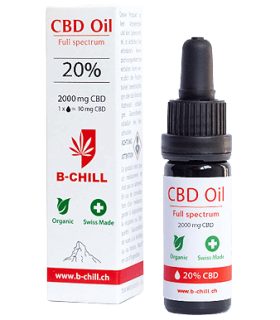
B-Chill CBD Oil 20% Full Spectrum Hemp Drops — 10 ml
CBD 2000 mgTHC 0.2%
With the CBD Oil 20%, B-Chill offers a full-spectrum CBD extract produced in Switzerland. Content sits at 20% CBD (2000 mg), with less than 1% THC. Supercritical CO₂ extraction without solvents retains CBG and CBC alongside CBD. The CBD drops are based on MCT coconut oil. This Swiss oil is lab tested, free from fungicides, herbicides, pesticides and solvent residues, additive-free, GMO-free and compliant on heavy metals.
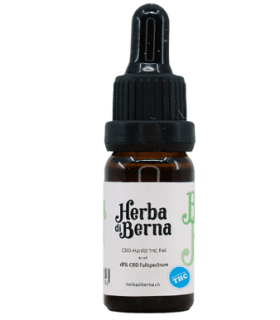
Herba di Berna CBD Oil 18% THC-Free Broad Spectrum Hemp Drops — 10 ml
CBD 1800 mg
With the CBD Oil 18%, Herba di Berna offers a broad-spectrum CBD extract produced in Switzerland. Content sits at 18% CBD (1800 mg), in a THC-free formulation. Supercritical CO₂ extraction without solvents retains CBG and CBC alongside CBD. The CBD drops are based on sunflower oil. This Swiss oil is lab tested, free from fungicides, herbicides, pesticides and solvent residues, additive-free, GMO-free and compliant on heavy metals.
Alpsbee Punch Day CBD Oil 22% Full Spectrum Hemp Drops — 10 ml
CBD 2200 mgTHC 0.2%
With Punch Day CBD Oil 22%, Alpsbee offers a full-spectrum CBD extract produced in Switzerland. Content sits at 22% CBD (2200 mg), with less than 1% THC. Ultrasonic extraction retains CBG alongside CBD. The CBD drops are based on MCT coconut oil. This Swiss oil is lab tested, free from fungicides, herbicides, pesticides and solvent residues, additive-free, GMO-free and compliant on heavy metals.
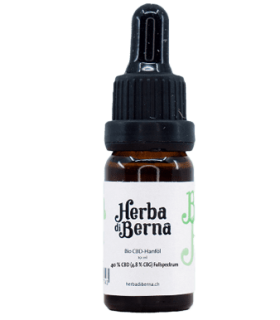
Herba di Berna CBD Oil 40% Full Spectrum Hemp Drops — 10 ml
CBD 4000 mgTHC 1.0%
The CBD Oil 40% by Herba di Berna is a full-spectrum CBD extract produced in Switzerland. At 40% CBD (4000 mg), it is an ultra-concentrated formula, with less than 1% THC. Extraction uses supercritical CO₂ without solvents, which preserves CBG, CBN and CBC alongside CBD. The extract is then blended into MCT coconut oil. The hemp extract is lab tested, free from fungicides, herbicides, pesticides and solvent residues, additive-free and GMO-free.
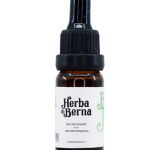
Herba di Berna CBD Oil 24% Full Spectrum Hemp Drops — 10 ml
CBD 2400 mgTHC 0.4%
With the CBD Oil 24%, Herba di Berna offers a full-spectrum CBD extract produced in Switzerland. Content sits at 24% CBD (2400 mg), with less than 1% THC. Supercritical CO₂ extraction without solvents retains CBG and CBC alongside CBD. The CBD drops are based on sunflower oil. This Swiss oil is lab tested, free from fungicides, herbicides, pesticides and solvent residues, additive-free, GMO-free and compliant on heavy metals.
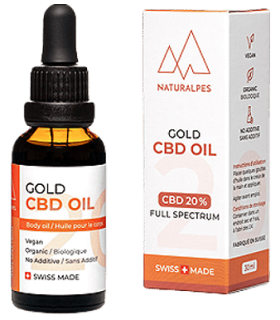
Naturalpes Gold CBD Oil 20% Full Spectrum Hemp Drops — 10 ml
CBD 2000 mgTHC 0.8%
With Gold CBD Oil 20%, Naturalpes offers a full-spectrum CBD extract produced in Switzerland. Content sits at 20% CBD (2000 mg), with less than 1% THC. Supercritical CO₂ extraction without solvents retains CBG, CBN and CBC alongside CBD. The CBD drops are based on hemp seed oil. This Swiss oil is made to ISO 9001, lab tested, free from fungicides, herbicides, pesticides and solvent residues, additive-free, GMO-free and compliant on heavy metals.
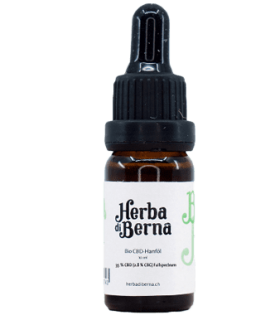
Herba di Berna CBD Oil 35% Full Spectrum Hemp Drops — 10 ml
CBD 3500 mgTHC 1.0%
With the CBD Oil 35%, Herba di Berna offers a full-spectrum CBD extract produced in Switzerland. Content sits at 35% CBD (3500 mg), with less than 1% THC. Supercritical CO₂ extraction without solvents retains CBG, CBN and CBC alongside CBD. The CBD drops are based on MCT coconut oil. This Swiss oil is lab tested, free from fungicides, herbicides, pesticides and solvent residues, additive-free, GMO-free and compliant on heavy metals.
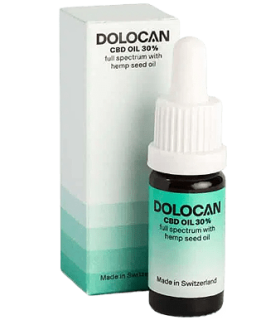
Dolocan CBD Oil 30% Full Spectrum Hemp Drops — 10 ml
CBD 3000 mgTHC 0.8%
The CBD Oil 30% by Dolocan is a full-spectrum CBD extract made in Switzerland. As a high-concentration formula, it delivers 30% CBD (3000 mg), with less than 1% THC. The extract is drawn with supercritical CO₂ without solvents, keeping CBG and CBC alongside CBD. The carrier oil is hemp seed oil. The CBD drops are lab tested, free from fungicides, herbicides, pesticides and solvent residues, additive-free, GMO-free and compliant on heavy metals.
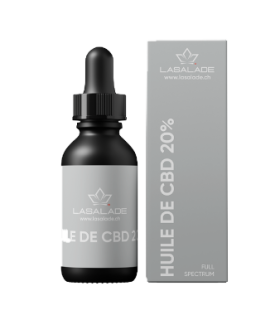
La Salade Natural CBD Oil 20% Full Spectrum Hemp Drops — 10 ml
CBD 2000 mgTHC 0.3%
With Natural CBD Oil 20%, La Salade offers a full-spectrum CBD extract produced in Switzerland. Content sits at 20% CBD (2000 mg), with less than 1% THC. Supercritical CO₂ extraction without solvents retains CBG, CBN and CBC alongside CBD. The CBD drops are based on MCT coconut oil. This Swiss oil is lab tested, free from fungicides, herbicides, pesticides and solvent residues, additive-free, GMO-free and compliant on heavy metals.
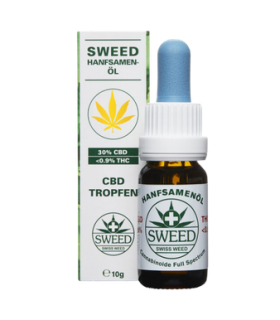
Sweed CBD Oil 30% Full Spectrum with Hemp Seed Oil — 10 ml
CBD 3000 mgTHC 0.9%
The CBD Oil 30% by Sweed is a full-spectrum CBD extract made in Switzerland. As a high-concentration formula, it delivers 30% CBD (3000 mg), with less than 1% THC. The extract is drawn with supercritical CO₂ without solvents, keeping CBG, CBN and CBC alongside CBD. The carrier oil is hemp seed oil. The CBD drops are lab tested, free from fungicides, herbicides, pesticides and solvent residues, additive-free and GMO-free.
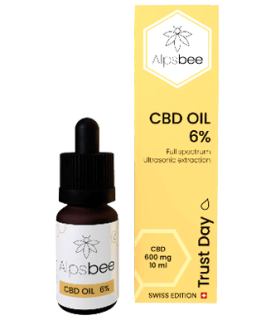
Alpsbee Trust CBD Oil 6% Full Spectrum Hemp Drops — 10 ml
CBD 600 mgTHC 0.1%
Trust CBD Oil 6% by Alpsbee is a full-spectrum CBD extract produced in Switzerland. At 6% CBD (600 mg), it is an entry-level formula, with less than 1% THC. Extraction uses ultrasound, which preserves CBN alongside CBD. The extract is then blended into MCT coconut oil. The hemp extract is lab tested, free from fungicides, herbicides, pesticides and solvent residues, additive-free, GMO-free and compliant on heavy metals.
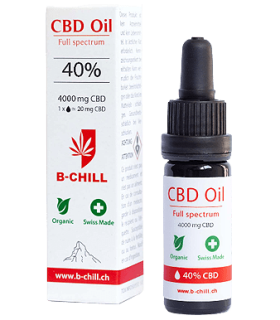
B-Chill CBD Oil 40% Full Spectrum Hemp Drops — 10 ml
CBD 4000 mgTHC 0.4%
The CBD Oil 40% by B-Chill is a full-spectrum CBD extract made in Switzerland. As an ultra-concentrated formula, it delivers 40% CBD (4000 mg), with less than 1% THC. The extract is drawn with supercritical CO₂ without solvents, keeping CBG and CBC alongside CBD. The carrier oil is MCT coconut oil. The CBD drops are lab tested, free from fungicides, herbicides, pesticides and solvent residues, additive-free and GMO-free.
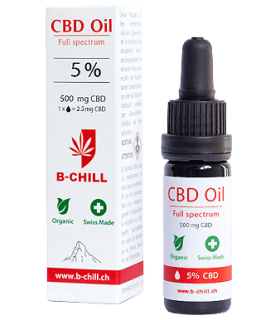
B-Chill CBD Oil 5% Full Spectrum Hemp Drops — 10 ml
CBD 500 mgTHC 0.1%
The CBD Oil 5% by B-Chill is a full-spectrum CBD extract made in Switzerland. As an entry-level formula, it delivers 5% CBD (500 mg), with less than 1% THC. The extract is drawn with supercritical CO₂ without solvents, keeping CBG and CBN alongside CBD. The carrier oil is MCT coconut oil. The CBD drops are lab tested, free from fungicides, herbicides, pesticides and solvent residues, additive-free, GMO-free and compliant on heavy metals.
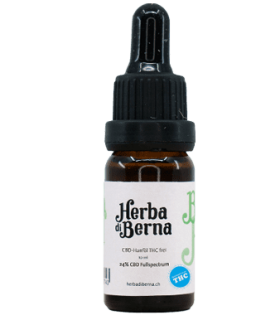
Herba di Berna CBD Oil 24% THC-Free Broad Spectrum Hemp Drops — 10 ml
CBD 2400 mg
The CBD Oil 24% by Herba di Berna is a broad-spectrum CBD extract produced in Switzerland. At 24% CBD (2400 mg), it is a concentrated formula, in a THC-free formulation. Extraction uses supercritical CO₂ without solvents, which preserves CBG and CBC alongside CBD. The extract is then blended into sunflower oil. The hemp extract is lab tested, free from fungicides, herbicides, pesticides and solvent residues, additive-free and GMO-free.
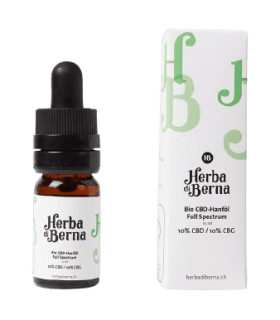
Herba di Berna Hemp Oil with 10% CBG + 10% CBD Full Spectrum Drops — 10 ml
CBG 1000 mgCBD 1000 mg
The Hemp Oil with 10% CBG + 10% by Herba di Berna is a full-spectrum CBG extract produced in Switzerland. At 10% CBG and 10% CBD, it is a balanced formula, with less than 1% THC. Extraction uses supercritical CO₂ without solvents, which preserves CBD and CBN alongside CBG. The extract is then blended into MCT coconut oil. The hemp extract is lab tested, free from fungicides, herbicides and pesticides, additive-free and GMO-free.
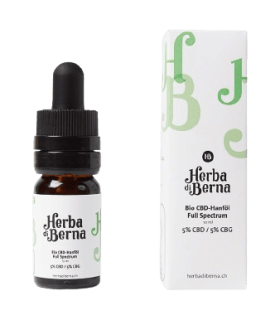
Herba di Berna Hemp Oil with 5% CBG + 5% CBD Full Spectrum Drops — 10 ml
CBG 500 mgCBD 500 mg
The Hemp Oil with 5% CBG + 5% by Herba di Berna is a full-spectrum CBG extract made in Switzerland. As an entry-level formula, it delivers 6% CBG and 5% CBD (500 mg CBD), with less than 1% THC. The extract is drawn with supercritical CO₂ without solvents, keeping CBD, CBN and CBC alongside CBG. The carrier oil is MCT coconut oil. The CBG drops are lab tested, free from fungicides, herbicides and pesticides, additive-free and GMO-free.
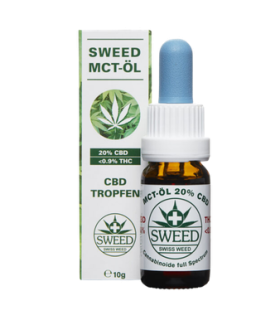
Sweed CBD Oil 20% Full Spectrum with MCT Oil — 10 ml
CBD 2000 mgTHC 0.7%
The CBD Oil 20% by Sweed is a full-spectrum CBD extract produced in Switzerland. At 20% CBD (2000 mg), it is a concentrated formula, with less than 1% THC. Extraction uses supercritical CO₂ without solvents, which preserves CBG, CBN and CBC alongside CBD. The extract is then blended into MCT coconut oil. The hemp extract is lab tested, free from fungicides, herbicides, pesticides and solvent residues, additive-free and GMO-free.
Alpsbee Nice Day CBD Oil 12% Full Spectrum Hemp Drops — 10 ml
CBD 1200 mgTHC 0.1%
Nice Day CBD Oil 12% by Alpsbee is a full-spectrum CBD extract made in Switzerland. As a balanced formula, it delivers 12% CBD (1200 mg), with less than 1% THC. The extract is drawn with ultrasound, keeping CBN and CBC alongside CBD. The carrier oil is MCT coconut oil. The CBD drops are lab tested, free from fungicides, herbicides, pesticides and solvent residues, additive-free, GMO-free and compliant on heavy metals.
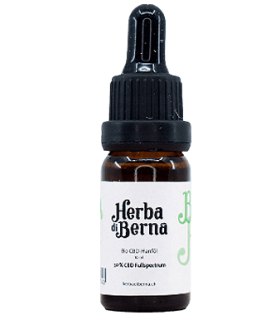
Herba di Berna CBD Oil 30% Full Spectrum Hemp Drops — 10 ml
CBD 3000 mgTHC 0.9%
The CBD Oil 30% by Herba di Berna is a full-spectrum CBD extract made in Switzerland. As a high-concentration formula, it delivers 30% CBD (3000 mg), with less than 1% THC. The extract is drawn with supercritical CO₂ without solvents, keeping CBG and CBC alongside CBD. The carrier oil is MCT coconut oil. The CBD drops are lab tested, free from fungicides, herbicides, pesticides and solvent residues, additive-free and GMO-free.
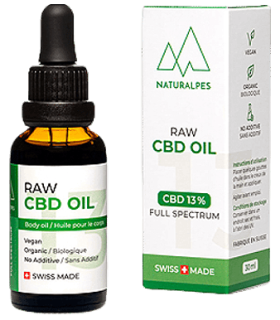
Naturalpes Raw CBD Oil 13% Full Spectrum Hemp Drops — 10 ml
CBD 1300 mgTHC 0.6%
Raw CBD Oil 13% by Naturalpes is a full-spectrum CBD extract produced in Switzerland. At 13% CBD (1300 mg), it is a balanced formula, with less than 1% THC. Extraction uses supercritical CO₂ without solvents, which preserves CBG and CBC alongside CBD. The extract is then blended into hemp seed oil. The hemp extract is lab tested, free from fungicides, herbicides, pesticides and solvent residues, additive-free and GMO-free.
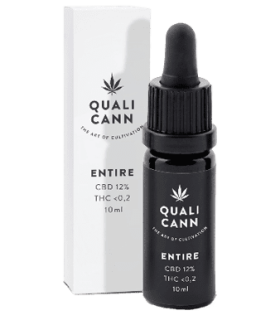
Qualicann Entire CBD Oil 12% Full Spectrum Hemp Drops — 10 ml
CBD 1200 mgTHC 0.1%
Entire CBD Oil 12% by Qualicann is a full-spectrum CBD extract produced in Switzerland. At 12% CBD (1200 mg), it is a balanced formula, with less than 1% THC. Extraction uses ethanol, which preserves CBG and CBC alongside CBD. The extract is then blended into hemp seed oil. The hemp extract is lab tested, free from fungicides, herbicides, pesticides and solvent residues and compliant on heavy metals.
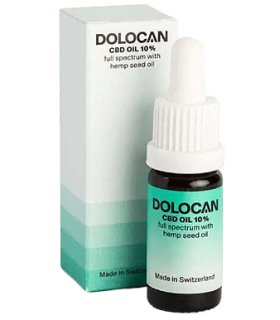
Dolocan CBD Oil 10% Full Spectrum Hemp Drops — 10 ml
CBD 1000 mgTHC 0.5%
With the CBD Oil 10%, Dolocan offers a full-spectrum CBD extract produced in Switzerland. Content sits at 10% CBD (1000 mg), with less than 1% THC. Supercritical CO₂ extraction without solvents retains CBG and CBC alongside CBD. The CBD drops are based on hemp seed oil. This Swiss oil is lab tested, free from fungicides, herbicides, pesticides and solvent residues, additive-free, GMO-free and compliant on heavy metals.
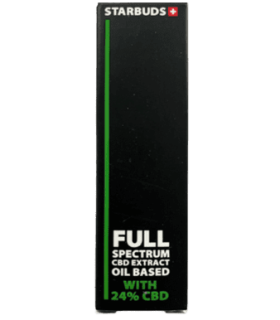
Starbuds CBD Oil 24% Full Spectrum Hemp Drops — 10 ml
CBD 2400 mgTHC 0.9%
The CBD Oil 24% by Starbuds is a full-spectrum CBD extract made in Switzerland. As a concentrated formula, it delivers 24% CBD (2400 mg), with less than 1% THC. The extract is drawn with supercritical CO₂ without solvents, keeping CBG, CBN and CBC alongside CBD. The carrier oil is sunflower oil. The CBD drops are lab tested, free from fungicides, herbicides, pesticides and solvent residues, additive-free, GMO-free and compliant on heavy metals.
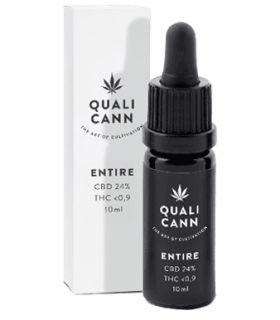
Qualicann Entire CBD Oil 24% Full Spectrum Hemp Drops — 10 ml
CBD 2400 mgTHC 0.6%
Entire CBD Oil 24% by Qualicann is a full-spectrum CBD extract made in Switzerland. As a concentrated formula, it delivers 24% CBD (2400 mg), with less than 1% THC. The extract is drawn with ethanol, keeping CBG, CBN and CBC alongside CBD. The carrier oil is hemp seed oil. The CBD drops are lab tested, free from fungicides, herbicides, pesticides and solvent residues and compliant on heavy metals.
Products 1-24 of 51
What is CBD oil?
CBD oil is a hemp extract containing cannabidiol (CBD), diluted in a carrier oil such as coconut (MCT) or hemp seed oil. The extract comes from the flower, not the seed. Unlike tetrahydrocannabinol (THC), cannabidiol is not intoxicating and does not make you high: a Swiss CBD oil holds under 1% THC.
Hemp and cannabis belong to the same species, Cannabis sativa L. — the varieties differ, not the genus. The oils on this page come from varieties bred for high cannabidiol and low THC.
In Switzerland, CBD oil is sold on the market as a cosmetic for external use or as an aroma oil, not as a medicine or a food supplement. Two components define every hemp oil sold on uWeed: the extract carries the plant compounds — cannabinoids, terpenes and flavonoids — while the carrier oil determines texture, odour and absorption. CBD drops, CBD tincture and hemp CBD oil all name the same object; hemp seed oil, by contrast, is a culinary oil pressed from the seeds and contains no cannabidiol.
What to look for when buying CBD oil?
Buying CBD oil online comes down to five things, and each is a property of the bottle rather than of you: the extract, the concentration, the price per milligram, the carrier oil and the lab report. They are ordered by how much each changes — the extract makes it a different product, the carrier oil only its texture. All five are filters in the shop, so you can narrow as you read.
1. The extract: What separates full-spectrum, broad-spectrum and isolate oils?
The three types of spectrum differ in which plant compounds survive extraction and filtering: full spectrum keeps them all, broad spectrum keeps all but the THC, isolate keeps only the cannabidiol.
The extraction process does not pull cannabinoids alone out of the hemp plants. It carries the terpenes, which hold the aroma, and the flavonoids, which give the extract part of its colour — and it is the whole set of these compounds that defines a spectrum.
| Spectrum | Compounds present | THC |
|---|---|---|
| Full spectrum | Cannabinoids, terpenes and flavonoids | Traces, under 1% |
| Broad spectrum | The same set, minus one cannabinoid | No detectable THC |
| Isolate | Cannabidiol alone | None |
Full spectrum keeps the other cannabinoids, the terpenes and the flavonoids alongside the cannabidiol, traces of THC under 1% included — the combined presence of these compounds is what the term entourage effect refers to. It is the most common spectrum in the range, and you can filter it directly in the full-spectrum CBD oil selection.
Broad spectrum carries the same set with the THC removed after extraction; the terpenes and flavonoids stay.
Isolate is purified cannabidiol with no other cannabinoids, no terpenes and no flavonoids. uWeed does not stock it as an oil.
2. CBD oil concentrations: from 5% to 50%
Each concentration delivers the same substance. I.e. Cannabidiol, in a different quantity: 5% corresponds to 500 mg of cannabidiol per bottle of 10ml, 50% is 5,000 mg. The table below summarizes the actual Cannabidiol content for different CBD cannabis oil concentrations:
| Concentration | mg of CBD per 10 ml bottle |
|---|---|
| CBD oil 5% | 500 mg |
| CBD oil 10% | 1,000 mg |
| CBD oil 20% | 2,000 mg |
| CBD oil 30% | 3,000 mg |
| CBD oil 40% | 4,000 mg |
| CBD oil 50% | 5,000 mg |
Between those two ends sit intermediate steps — 6%, 10%, 12%, 15%, 16%, 18%, 20%, 22% 24%, 25%, 30%, 32% and 35% — so the range is much finer than these five rows suggest. Narrow it with the CBD content filter in the category page to find what suits you best.
3. The price: what does CBD oil cost per milligram of cannabidiol?
CBD oil is priced per bottle, but it is only comparable per milligram of cannabidiol — divide the bottle price by the milligrams on the label and you have the one figure that works across brands. Because every oil here ships in the same 10 ml bottle, that number needs no further arithmetic.
The spread across the range is wide, and concentration does not predict it: single-digit percentages sit at both the cheapest and the most expensive end, with the strong oils in between. So the bottle price tells you little about how much cannabidiol you are getting — a cheap small bottle can be the dearest per milligram, and the reverse happens too. CBD oil prices are in Swiss francs and set by the producers, not by uWeed.
4. The carrier oil: MCT, hemp seed, sunflower and olive oil
Every CBD oil is an extract diluted in a carrier oil, and that carrier determines the texture, colour and odour of the finished bottle — not the quality of the extract inside it. Three carriers run through the range, and a fourth turns up elsewhere in the sector:
- Coconut oil (MCT)— the most common carrier oil for CBD. Colourless and very thin, it leaves the extract's own odour in the foreground. It solidifies in the cold and turns clear again at room temperature, with no effect on the product.
- Hemp seed oil — deeper colour, tending to green, and a distinctly vegetal note, because carrier and extract come from the same plant. More prone to oxidation than MCT.
- Sunflower oil — the middle option: slightly thicker than MCT, quieter in odour than hemp seed, and neutral in colour.
- Olive oil — thick, with a pronounced odour. Used elsewhere in the sector, it appears in none of the CBD oils currently listed at uWeed; it is named here because you will meet it in other shops.
5. Lab reports and certificates of analysis
A CBD oil's certificate of analysis (CoA) is the document that turns a claimed cannabinoid content into a measured one, and there is one available for every product in this category. Two things appear on all of them:
- the cannabinoid profile of the extract, CBD and THC included,
- the measured THC content, which is what places the oil under the Swiss 1% limit.
Some certificates go further and report screenings for pesticides, heavy metals or residual solvents. These are additional analyses rather than a standard part of every report, so their absence tells you nothing about the oil — only that the producer did not commission that particular test.
A certificate reflects the material that was analysed, so it is worth checking the date and, where the producer works with batch numbers, that the number on the report matches the bottle. Not every producer numbers batches, and many issue one certificate per production run instead. uWeed collects, checks and publishes the producers' reports; the analysis is run by the producer's own laboratory or by a commissioned third party.
How is CBD extract made?
CBD extract is made by separating the compounds of the hemp flower — cannabinoids, terpenes and flavonoids — from the rest of the plant, then decarboxylating and filtering them.
Three stages, in that order.
- The extraction itself is most often done with supercritical CO₂, a solvent-free process that preserves terpenes heat would destroy. Ethanol and ultrasonic extraction turn up more rarely.
- Decarboxylation then converts the acidic form of the cannabinoid, as it exists in the plant, into cannabidiol.
- Filtering finishes the job, and how far it goes explains the colour differences visible in the grid: raw stays dark and still holds plant waxes, decarboxylated turns golden, distilled is clear.
Filter by Extraction method if the process matters to you, or read the details on CBD extraction methods.
Is CBD oil legal in Switzerland?
Yes, CBD oils are sold freely in Switzerland on one condition: their THC-content lies under 1%. That is the Swiss threshold, and it is verified on the analysed material rather than claimed.
Swiss CBD drops are placed on the market as a cosmetic for external use on the skin or as an aroma oil — so as a chemical product, not as a medicine, a food or a food supplement. That classification explains an absence you may notice: no sublingual CBD oil is legal in Switzerland, because no oil may be declared here for ingestion. You will find nothing on this page presented for sublingual use, and that is deliberate.
Under 1% THC, CBD oil is non-intoxicating. The hemp is grown in Switzerland, and the certificate of analysis gives you the THC content actually measured — a figure, not a promise from the producer. The full framework is set out in the article on CBD oil legality in Switzerland.
Only Swiss brands, no house label or European producers
You can buy Swiss CBD oil right here, from independent producers. uWeed makes none of these oils and has no house label — so there is no reason to push one bottle over another. What you are looking at is a comparison, not a shop window.
🌱 One of the largest CBD selections in Switzerland, from producers vetted before listing.
🔍 The producer's certificate of analysis, published for every product.
🇨🇭 Delivery within 24 hours anywhere in Switzerland, in neutral, discreet packaging.
🎁 uWeed Club: 5% cashback on every order.
That is what makes the comparison possible: a brand's own shop can only show you its own line, whereas here every CBD oil is judged on the same criteria — spectrum, concentration, price per milligram, carrier oil.
Frequently Asked Questions About CBD Oil
What's the difference between CBD oil, hemp oil and cannabis oil?
CBD oil, hemp oil and cannabis oil differ in which part of the plant is used and which variety it comes from. Hemp seed oil is cold-pressed from the seeds, which hold no cannabinoids: it is a culinary oil with no cannabidiol. CBD oil is a flower extract from varieties bred for high cannabidiol, diluted in a carrier oil. “Cannabis oil” is the broader term: in Switzerland, a cannabis oil is only freely sold with under 1% THC, and it is then a CBD oil like the ones on this page.
Which is the best CBD oil in Switzerland?
No oil is best on every point: compare them on CBD concentration, spectrum (full spectrum or broad spectrum), carrier oil (MCT, hemp seed or sunflower) and price per gram of CBD. Every oil here comes from a Swiss producer, contains under 1% THC and has its lab report on the product page.
How should CBD hemp drops be stored?
Hemp drops keep best away from light, in a cool place and in their original bottle. Light and heat break cannabinoids down over time: that is what the amber glass is for, and the reason the bottle belongs neither on a windowsill nor above the cooker. A cupboard or a drawer is enough — the fridge is not necessary. The shelf life of CBD oil runs from opening and is printed on the label.